
Blog posts tagged "containers"

Canonical, the publisher of Ubuntu, is pleased to announce a new partnership with developer-focused cybersecurity company Snyk. Snyk Container, Snyk’s container security solution, now offers native support for scanning chiseled Ubuntu containers. This partnership will create a path to a more secure container ecosystem, where developers wi

This blog is contributed by Pushkar Kulkarni, a Software Engineer at Canonical. Building on the rise in popularity of Spring Boot and the 12 factor paradigm, our Java offering also includes a way to package Spring workloads in production grade, minimal, well organized containers with a single command. This way, any developer can generate

This blog is contributed by Vladimir Petko, a Software Engineer at Canonical. The release of Plucky Puffin earlier this year introduced the availability of the devpack for Spring, a new snap that streamlines the setup of developer environments for Spring on Ubuntu. In this blog, we’ll explain what devpacks are and provide an overview of

Today we are announcing chiseled containers for OpenJRE 8, 17 and 21 (Open Java Runtime Environment), coming from the OpenJDK project. These images are highly optimized for size and security, containing only the dependencies that are strictly necessary. They are available for both AMD64 and ARM64 architectures and benefit from 12 years of

Java has long been the most popular language for software development in large enterprises, with 90% of Fortune 500 companies using it for backend development, particularly in industries like finance, healthcare, and government. Java developers, more than most, are tasked with balancing the implementation of new features against the crit

Software supply chain security has become a top concern for developers, DevOps engineers, and IT leaders. High-profile breaches and dependency compromises have shown that open source components can introduce risk if not properly vetted and maintained. Although containerization has become commonplace in contemporary development and deploym

It’s hard to believe that the first KubeCon took place nearly 10 years ago. Back then, Kubernetes was still in its early days, and the world was only just beginning to understand the power of container orchestration. Fast-forward to today, and Kubernetes is a fundamental part of cloud-native development, taught in universities as a key

Introducing trusted open source database containers It’s time to stop proclaiming that “cloud native is the future”. Kubernetes has just celebrated its 10 year anniversary, and 76% of respondents to the latest CNCF Annual Survey reported that they have adopted cloud native technologies, like containers, for much or all of their productio

We are ready to connect with the pioneers of open-source innovation! Canonical, the force behind Ubuntu, is returning as a gold sponsor at KubeCon + CloudNativeCon North America 2024. This premier event, hosted by the Cloud Native Computing Foundation, brings together the brightest minds in open source and cloud-native technologies. From
Since the outset, Anbox Cloud was developed with a variety of use cases for running Android at scale. Cloud gaming, more specifically for casual games as found on most user’s mobile devices, is the most prominent one and growing in popularity. Enterprises are challenged to find a solution that can keep up with the increasing

We’ve all heard about cloud-native applications in recent years, but what about cloud-native infrastructure? Is there any reason why the infrastructure couldn’t be cloud-native, too? Or maybe it’s already cloud-native, but you’ve never had a chance to dive deep into the stack to check it out? What does the term “cloud-native infrastructur

Google Kubernetes Engine (GKE) traces its roots back to Google’s development of Borg in 2004, a Google internal system managing clusters and applications. In 2014, Google introduced Kubernetes, an open-source platform based on Borg’s principles, gaining rapid popularity for automating containerized application deployment. In 2015, Google
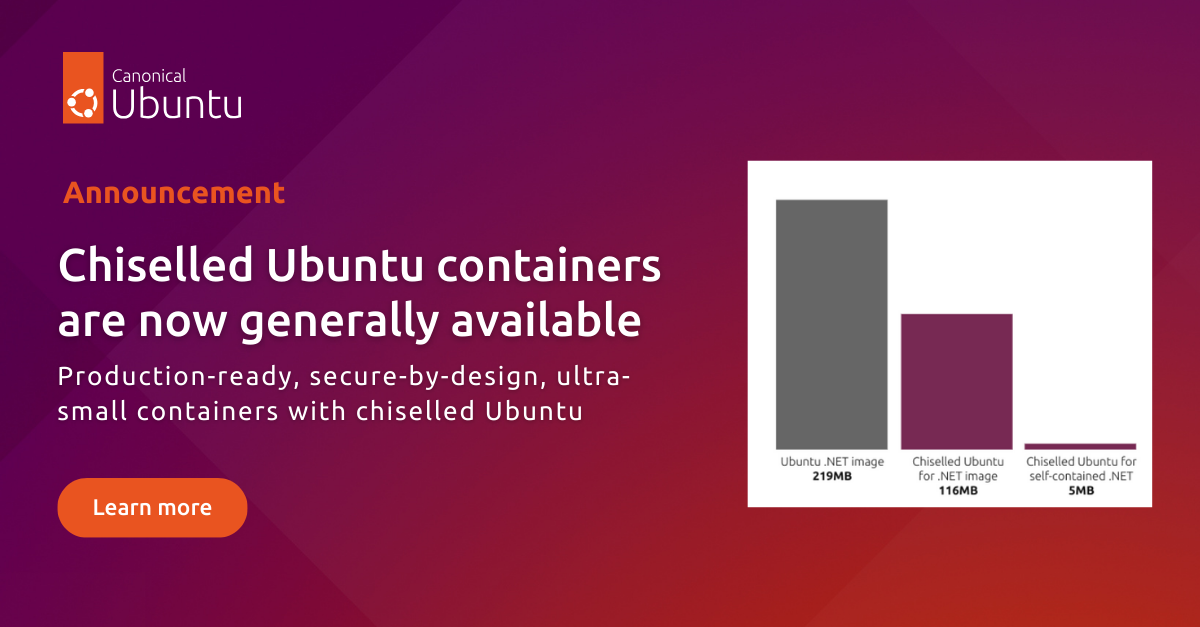
Production-ready, secure-by-design, ultra-small containers with chiselled Ubuntu Canonical announced today the general availability of chiselled Ubuntu containers which come with Canonical’s security maintenance and support commitment. Chiselled Ubuntu containers are ultra-small OCI images that deliver only the application and its runtime

Find us at the booth #54 or join a special joint session on November 14th at 2:15 PM.

오늘날 급변하는 디지털 환경에서 강력한 도커 컨테이너 보안 조치의 중요성은 아무리 강조해도 지나치지 않습니다. 컨테이너화된 계층도 규정 준수 표준의 적용을 받기 때문에 보안 문제 및 규정 준수 요구 사항이 발생합니다. 도커 컨테이너 보안 조치는 경량의 어플라이언스 유형 컨테이너(각 캡슐화 코드 및 해당 종속성)를 위협 및 취약성으로부터 보호하는 것을 수반합니다. 민감한 개인 데이터를 처리하는 데 의존하는
In today’s rapidly changing digital environment, the significance of robust Docker container security measures cannot be overstated. Even the containerised layer is subject to compliance standards, which raise security concerns and compliance requirements.